
The Weenat app puts the key indicators in your hands to manage your irrigation with precision. Connected to your Tensiometric Probes, Capacitive Probes or Fertigation Probes, it transforms soil moisture data into concrete decisions: when to irrigate, how much water to apply, when to stop.
Five essential features, one single app:
- The Available Water Reservoir (NEW)
- Hydraulic Thresholds
- Potential evapotranspiration (ETP) and rainfall tracking
- Irrigation totals
- Custom alerts
1. NEW: the Available Water Reservoir, to know the water level in your soil
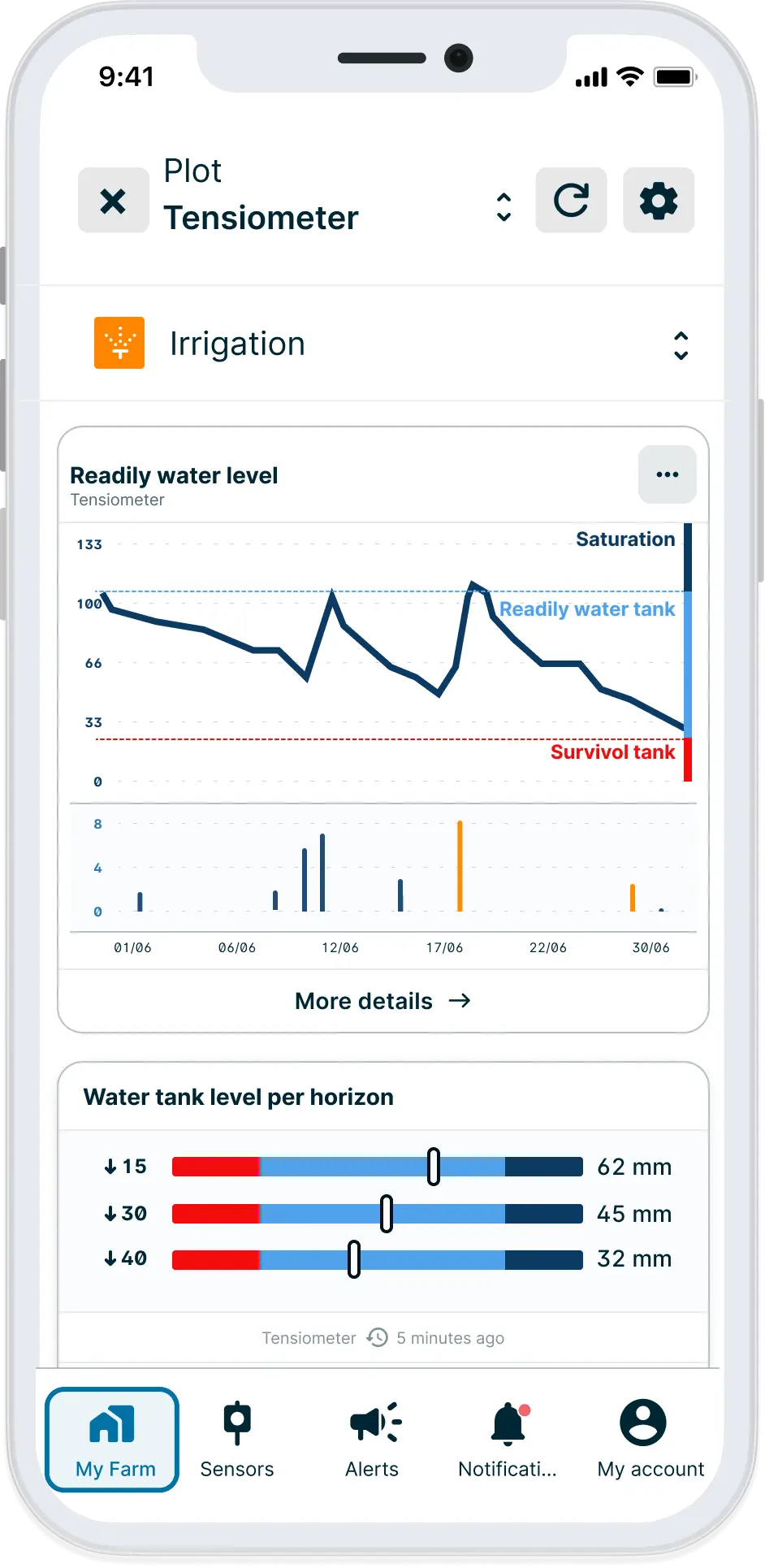
This is the latest feature added to the Weenat app. And it changes the way you read your irrigation.
Between the kPa readings of Tensiometers and the volumetric moisture percentages of Capacitive Probes, data can quickly become difficult to interpret, especially at the start of the season.
The Available Water Reservoir solves this problem: it translates your probe measurements in real time into millimetres of water available for your crops, at the exact depth where your sensors are installed.
Why millimetres?
It is the unit common to both meteorology and water balances. By thinking in mm, you directly compare what remains in your soil with what rainfall will bring or what ETP will consume.
No more converting: you see the deficit and apply exactly what is needed.
A soil model built on 4 years of R&D
The calculation is based on a model developed from thousands of soil samples taken from pilot farms representative of the main French and European texture types.
For each texture, Weenat has identified two key values: field capacity (pF 2, i.e. approximately 10 kPa) and the permanent wilting point (pF 4.2). These two boundaries define the Readily Available Water, and a retention coefficient specific to each texture converts your probe data into mm with no configuration required on your part. You can however refine the model by entering your soil texture to gain even more precision.
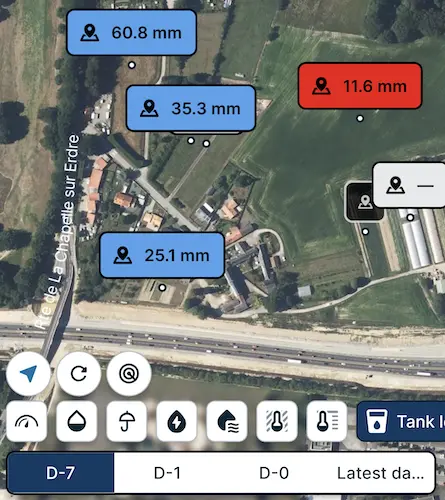
From the My Farm screen, you can see at a glance the water level of all your equipped plots: you identify where to irrigate first, and where you can wait.
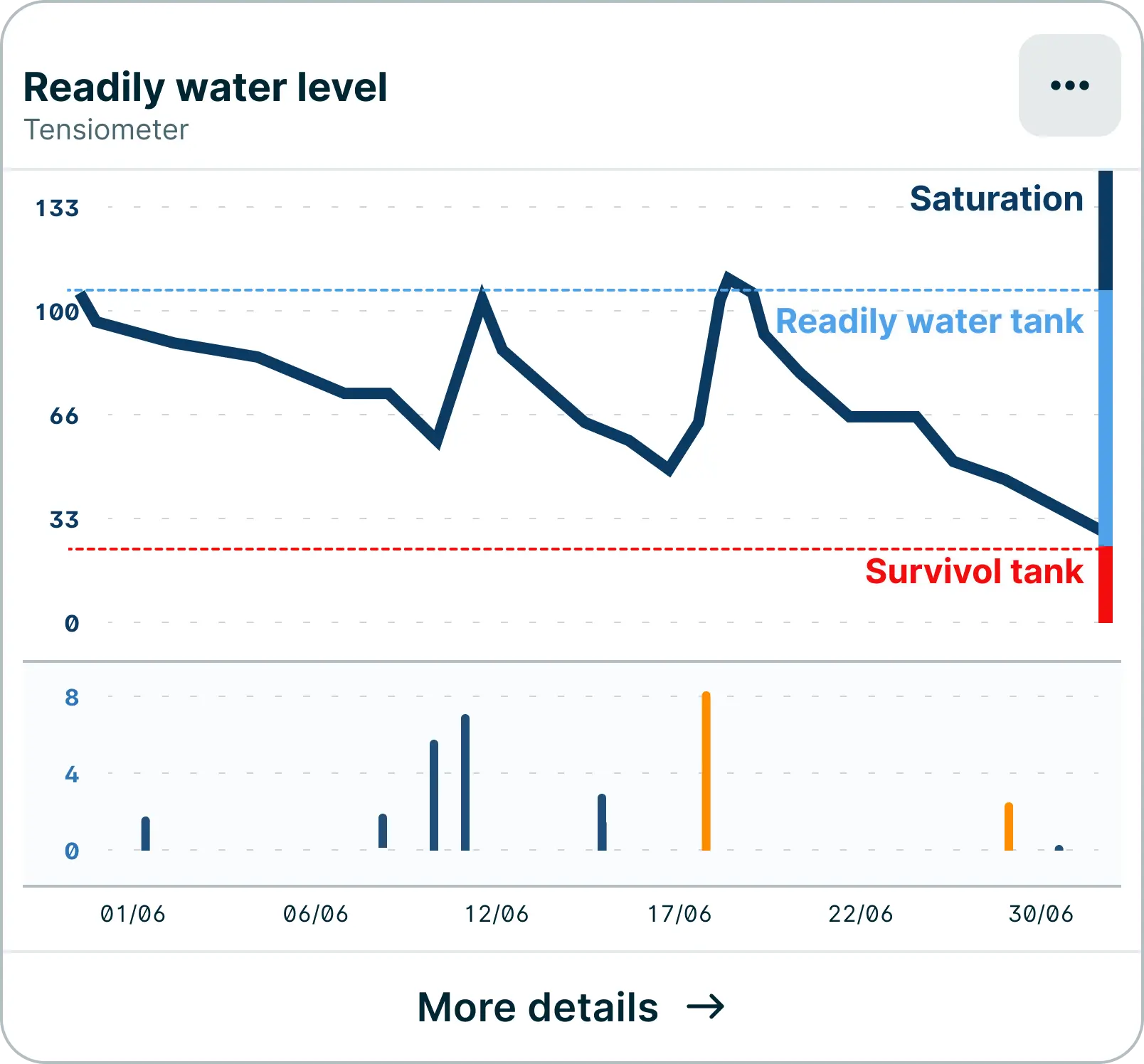
Three reading levels on your graph:
- Reservoir full. The soil is at maximum capacity. No need to irrigate.
- Readily Water Tank. The reserve is gradually decreasing. You follow the dynamics and anticipate the next irrigation cycle.
- Survival Tank. Critical threshold: irrigate without delay to avoid water stress.
Rainfall and irrigation are displayed on the same graph, so you can immediately visualise the impact of each input.
The Available Water Reservoir does not replace your probe curves: it complements them.
You still have access to raw data in kPa or % volumetric moisture, and you cross-reference this field reading with the actual water available in mm. The same value of 50 kPa does not reflect the same reality in a sandy soil as in a silty soil: the model integrates this difference to give you the decision-relevant information directly.
2. Hydraulic Thresholds: 4 colours, 4 decisions
Your probes measure soil moisture or tension.
But you still need to know what to do with that data.
Hydraulic Thresholds are Weenat’s in-house decision support tool.
Their role: to translate the raw data from your Tensiometers or Capacitive Probe into an ultra-intuitive visual reference. On screen, you immediately see what state your soil moisture is in.
Four thresholds, four colours, four reflexes:
- Saturation – Too much water in the soil. Wait before irrigating.
- Comfort – Ideal level. Nothing to do; your crops have exactly what they need.
- Vigilance – Your crops are starting to run short of water. Prepare your next irrigation cycle.
- Water stress – Urgent: irrigate as quickly as possible to limit losses.

Goal throughout the season: keep your curve in the Comfort zone. If it shifts to Vigilance, you know you need to act. If it plunges into Water stress, you have waited too long.
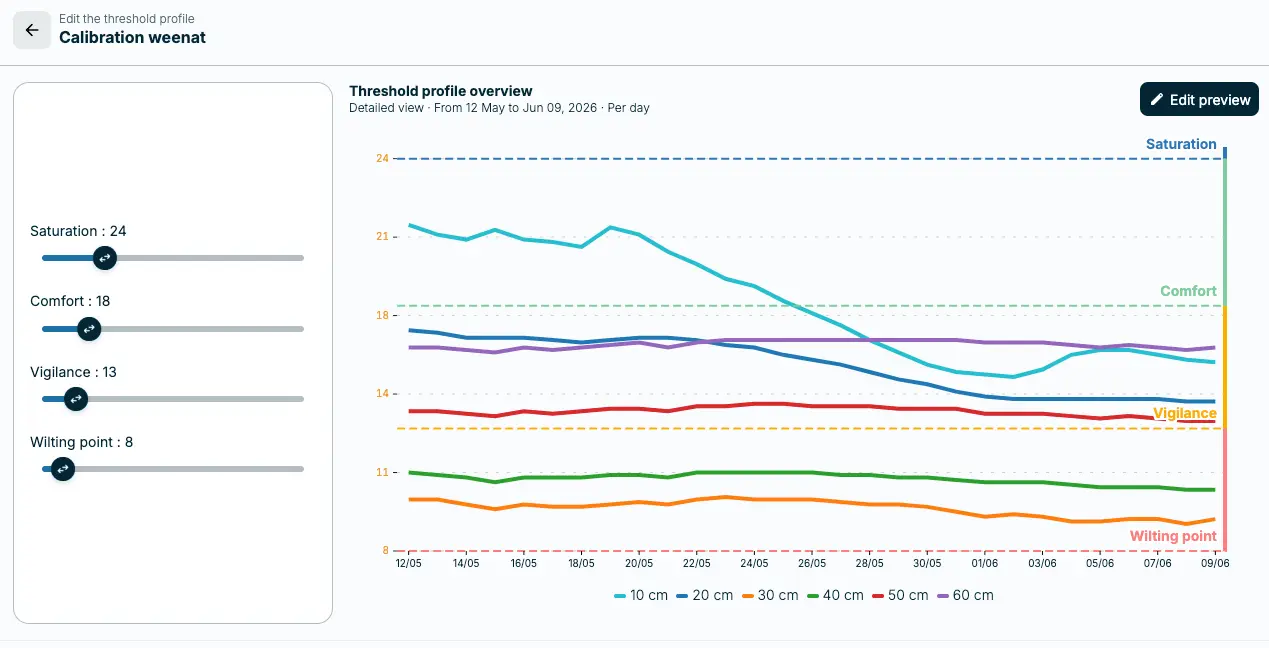
Note: Hydraulic Thresholds are configurable. You enter your soil type via the texture triangle and the tool adapts automatically. You can also fine-tune the thresholds manually, depending on your crops and technical objectives.
3. Potential evapotranspiration (ETP) and rainfall: 14 days of visibility
Managing irrigation by instinct is over.
With the Weenat app, you visualise the rainfall and potential evapotranspiration (ETP) of the past 7 days, as well as forecasts for the next 7. That is 14 days of visibility to make decisions without flying blind.
Three concrete uses:
- Anticipate an irrigation cycle. You see 8 mm of rain forecast for tomorrow? You save your irrigation cycle today. And your water and electricity bill with it.
- Calculate the actual crop requirement. ETP tells you what the plant has consumed. Rainfall tells you what has returned naturally. The difference is exactly what you need to compensate through irrigation. No more guesswork doses.
- Decide with a clear horizon. With 7 days of history and 7 days of forecasts displayed on the same timeline, you calmly choose between triggering, waiting or postponing.
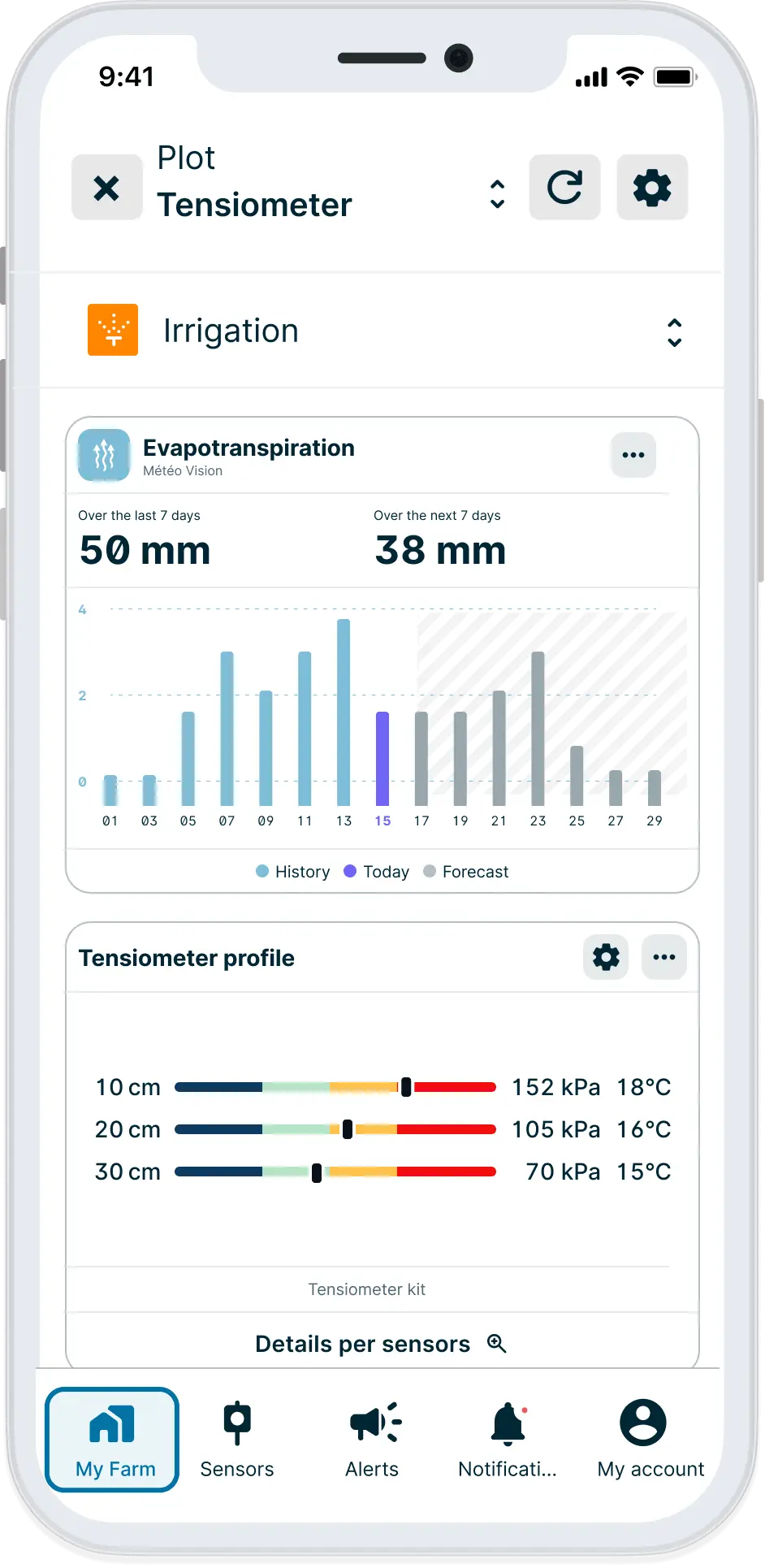
ETP is calculated by Meteo Vision, Weenat’s spatialised weather solution, with km² precision.
No additional sensor needed: the data is directly integrated into the app.
4. Irrigation totals: visualise the effect of each irrigation cycle
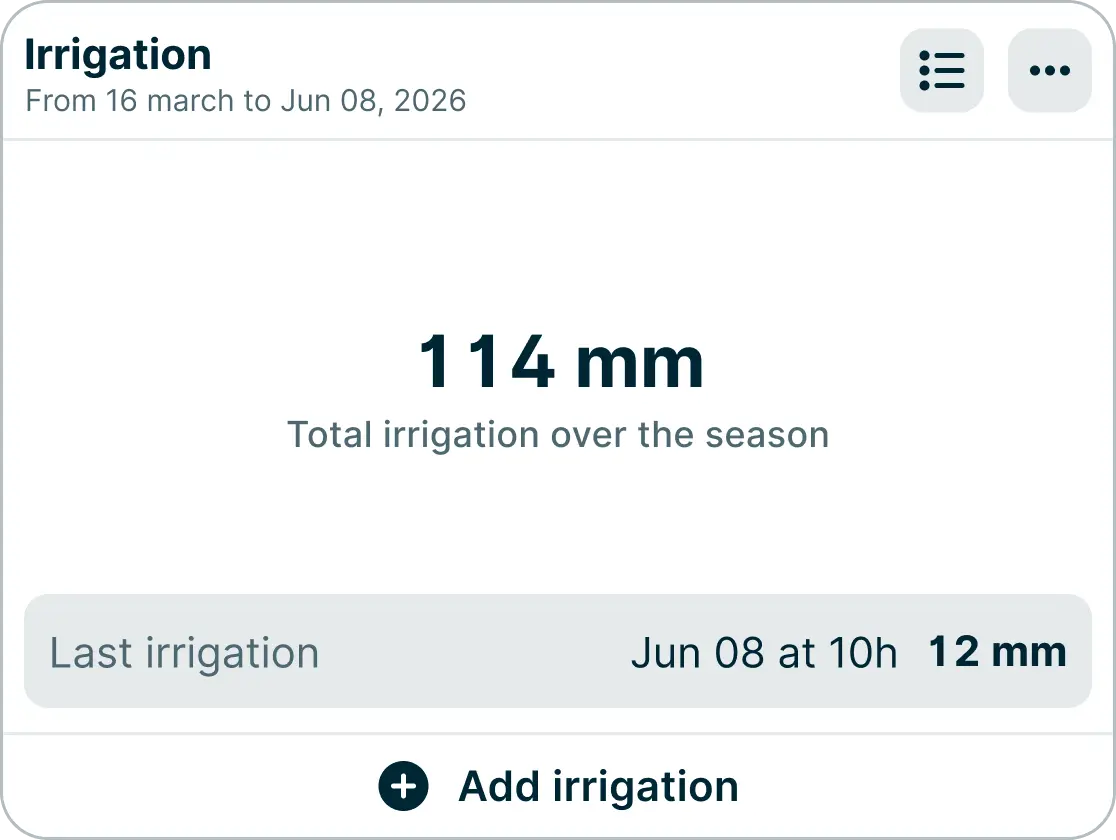
Log each irrigation in the app. Enter the date and the dose applied. And observe on your probe curve the impact of that input on soil moisture, alongside recorded rainfall.
Why?
- A complete overview of your inputs. Rainfall and irrigation are displayed on the same timeline as your probe measurements. At a glance, you see what has entered the soil and how your crops have consumed it.
- The effect of each irrigation cycle, made visible. By cross-referencing your irrigations with water content curves, you see whether the water has properly recharged the soil at depth. Or whether it stopped at 30 cm without reaching the roots.
- Volume optimisation, season after season. You adjust the duration and frequency of your irrigations. You gain precision without risking water stress. And you build up a solid history to manage better next year.
The app automatically totals your irrigation cumulative for the season. You know at all times how much water you have applied.
5. Custom alerts: your probes watch over you
You do not have time to open the app 10 times a day. Your probes do.
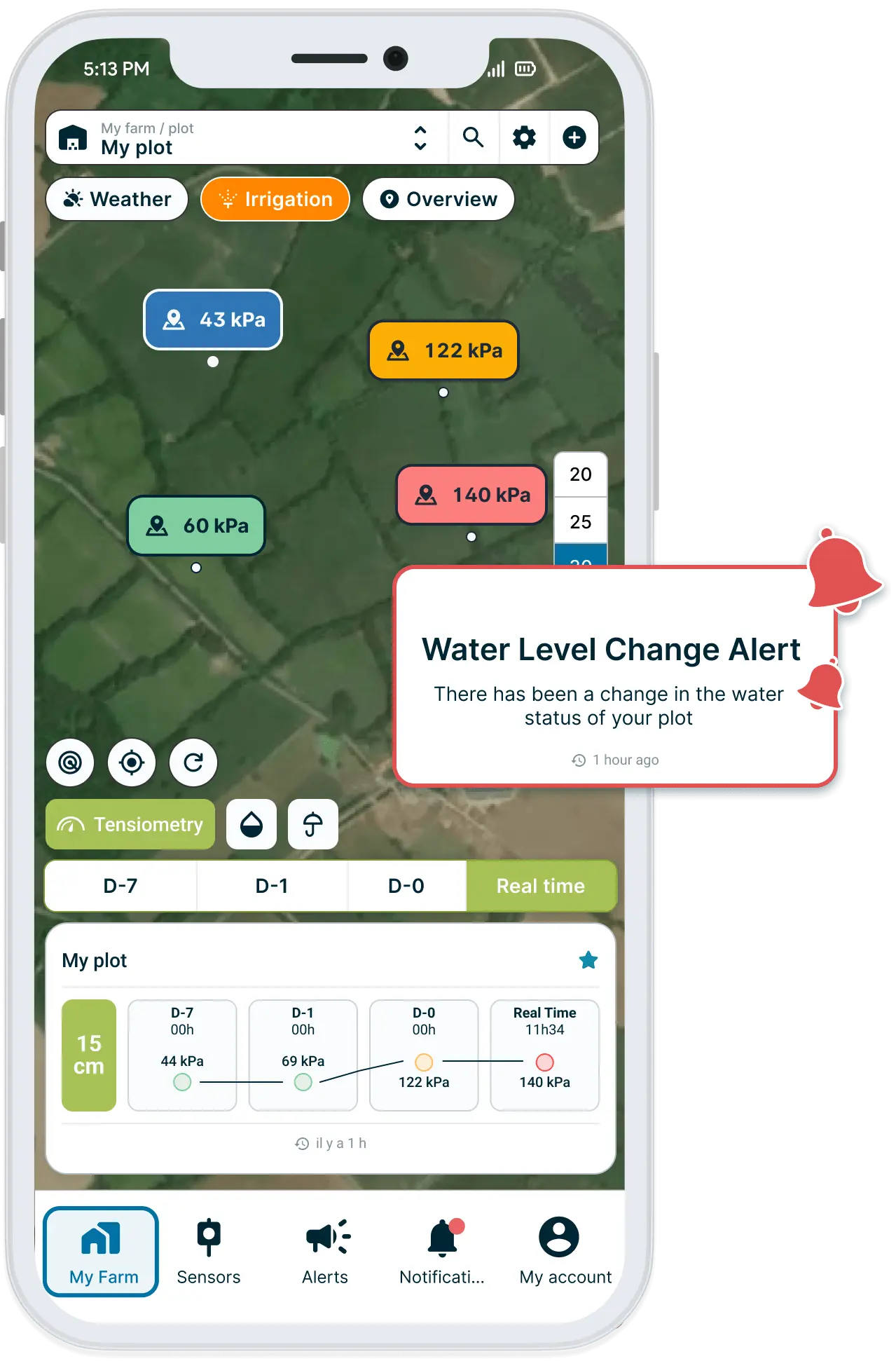
Weenat’s personalised alert system notifies you as soon as a hydraulic threshold is crossed. Your parameters are set once; the app monitors and alerts you at the right moment.
Three immediate benefits:
- You are notified in case of rain or a change of state. No more back-and-forth trips to the field to check. Your alerts watch over you, day and night.
- You react as soon as soil moisture changes. Your Hydraulic Thresholds shift to Vigilance? Instant alert to trigger an irrigation cycle in time, before your crops enter stress.
- You stay in control without being glued to the app. You set your parameters once (which horizon to monitor, which threshold, which channel). The app takes over.
As Stéphane Dahirel, arable farmer in Morbihan, puts it:

“If we reach the water stress zone, it is already too late. That is why I have set up an alert to notify me in case I lose vigilance.”
Unlock the full potential of your irrigation management!
Available Water Reservoir, Hydraulic Thresholds, potential evapotranspiration and rainfall, irrigation totals, personalised alerts. Every feature is designed to answer a concrete question at a specific moment in your irrigation season.
All these features are accessible with the installation of soil moisture probes.
Contact us to get your custom quote.


FAQ: the benefits of irrigation management with the Weenat app
According to an Inrae study, managing irrigation with connected soil moisture probes saves an average of 20% of water per season. The 2017 Irstea study goes further and estimates the potential saving at between 8% and 41% depending on the irrigation system, soil type and crop. The Weenat app translates probe data into concrete decisions, making it possible to achieve these savings without risking water stress.
Savings apply to both water and energy (pumping, electricity). The Coccolo Group, a fruit grower with 370 hectares of orchards across Provence and Occitania, saved approximately €30,000 in the very first year of using connected probes and the Weenat app on their water and energy bills. The return on investment of an irrigation management kit is generally achieved within one to two seasons.
Yes. By avoiding both water stress (which penalises the growth and quality of fruit or grain) and saturation (which risks suffocating the roots), precision irrigation secures yield potential. You apply water at the right time, at the right dose, where the plant needs it. You increase your production while consuming less.
Yes. No more checking soil moisture with a spade or making trips to the field after every rainfall. All data is accessible on mobile or computer. Jean-Michel Morille, a farmer in Loire-Atlantique, reports saving one hour per day during the growing cycle thanks to Weenat Tensiometers connected to the app.
Yes. The app integrates its own decision support tools (Hydraulic Thresholds, Available Water Reservoir) and connects to the best water balance systems on the market: Irré-LIS® (ARVALIS) for arable crops, Vintel for vineyards, as well as crop protection decision support tools such as DeciTrait®, Mileos® and RIMpro. You centralise all your management indicators in one single app.
